Evaluating the "Feelin Lucky" Bear for St. Patrick's Day Sublimation Projects
As the season for St. Patrick's Day approaches, crafters and small business owners often face the challenge of selecting designs that balance festive tradition with modern appeal. The "Feelin Lucky" bear motif has emerged as a distinct option in the sublimation market, offering a departure from the standard leprechaun and shamrock tropes. When evaluating digital assets for printing, specifically high-resolution PNG files intended for transfer onto apparel or hard goods, understanding the specific utility and limitations of a design is crucial. This analysis explores the characteristics of the "Feelin Lucky" bear concept, compares it against traditional holiday graphics, and outlines the practical considerations for integrating this style into a broader product line.
Defining the Aesthetic and Utility
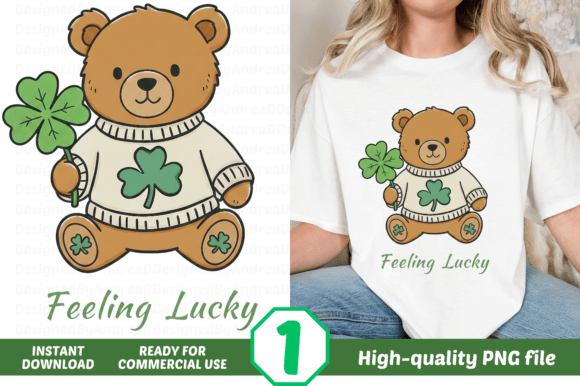
The core appeal of the "Feelin Lucky" bear design lies in its fusion of cute animal imagery with holiday-specific wordplay. Unlike generic text-based designs or complex illustrative scenes, this category typically features a central character—a bear—styled with accessories such as green hats, clovers, or plaid patterns, accompanied by the phrase "Feelin Lucky." From a production standpoint, the value of such a design is heavily dependent on the file format and resolution. A 300 DPI (dots per inch) PNG is the industry standard for sublimation because it ensures crisp edges and vibrant color retention when heat-pressed onto polyester substrates.
What makes this specific theme distinct is its versatility across demographics. Traditional St. Patrick's Day imagery often skews toward adult-oriented pub culture or very young children's cartoons. The bear motif occupies a middle ground, appealing to adults who appreciate whimsical or "kawaii" aesthetics without appearing juvenile. For a creator deciding between purchasing a single design file versus a bulk bundle, the "Feelin Lucky" bear represents a targeted asset. It is not a background pattern or a border element; it is a focal point. This distinction matters when planning inventory, as focal point designs are best suited for the center of t-shirts, the front of mugs, or the face of tote bags, whereas patterns serve better as all-over prints or background fills.
Comparative Analysis: Character Designs vs. Traditional Typography
When researching resources for holiday merchandise, one must weigh character-driven designs against purely typographic options. Traditional St. Patrick's Day designs often rely exclusively on stylized fonts spelling out phrases like "Kiss Me I'm Irish" or "Luck of the Irish." While these have enduring popularity, they lack the emotional connection that an illustrated character can provide. The "Feelin Lucky" bear offers a narrative element; the character itself conveys a mood of playfulness and contentment.
However, there are tradeoffs to consider. Typographic designs are often easier to customize. If a customer requests a color change in the text or a slight alteration to the wording, a vector-based text design is simple to edit. In contrast, a raster-based PNG of a bear, even at 300 DPI, is a flat image. While it can be resized easily using various software programs, altering the internal colors of the bear or the text within the image requires advanced graphic editing skills and can degrade image quality if not done correctly. Therefore, if your business model relies heavily on personalization and on-the-fly edits, a character PNG might be less flexible than a layered vector file. Conversely, if your goal is rapid production of consistent, high-quality visuals where the artwork is the selling point, the pre-rendered PNG offers superior visual fidelity without the need for design assembly.
Material Compatibility and Application Scenarios
The suitability of the "Feelin Lucky" bear design extends beyond just t-shirts. Sublimation printing allows for transfer onto any item with a polymer coating or high polyester content. This opens a wide array of application scenarios that should be evaluated before purchase. For instance, the rounded shape of a bear illustration often complements curved surfaces like tumblers and mugs better than wide, horizontal text banners. The vertical orientation of many character designs fits well on the narrow profile of a water bottle or a phone case.
Consider the end-use environment. St. Patrick's Day apparel is often worn in casual, outdoor, or social settings. A design featuring a bear is generally perceived as softer and more approachable, making it an excellent choice for family matching sets, children's clothing, or items intended as gifts. In comparison, edgier or more abstract designs might resonate better with a niche audience looking for statement pieces. Furthermore, the "Feelin Lucky" theme translates well to non-apparel items such as scrapbooking paper, wall decoration frames, and greeting cards. The high resolution ensures that even when scaled down for a card or a sticker, the details of the bear's expression and the texture of the green elements remain sharp.
Strengths and Limitations in Production
Every design asset comes with inherent strengths and limitations that impact workflow. The primary strength of a dedicated 300 DPI PNG file is consistency. Every print will look exactly as the designer intended, eliminating variables associated with font rendering or color profiling errors that can occur when assembling a design from scratch. For businesses scaling up production during the busy March season, this reliability is invaluable. It reduces the time spent on quality control and ensures that a batch of fifty shirts looks uniform.
On the other hand, the limitation lies in exclusivity and saturation. Because PNG files are easy to distribute, popular designs like the "Feelin Lucky" bear can become ubiquitous if too many vendors utilize the same source file. To mitigate this, savvy creators often combine the base design with other elements—adding unique backgrounds, layering additional glitter textures, or incorporating the image into a larger collage. This approach allows you to leverage the strong central imagery while maintaining a unique product identity. Additionally, since the file is a single layer, you are limited to the transparency provided. You cannot isolate the bear from the text without meticulous photo editing, which may not be feasible for all users.
Decision Factors for Buyers and Creators
Ultimately, choosing whether to integrate the "Feelin Lucky" bear into your project lineup depends on your specific business goals and technical capabilities. If you are an individual hobbyist looking to create personalized gifts for family members, this type of design offers a professional finish with minimal effort. The ability to resize the image for different projects—from a large pillow cover to a small keychain—adds significant value to a single download.
For entrepreneurs expanding a printing business, the decision should be based on market demand. Analyze your previous sales data: do your customers respond better to cute animals or bold typography? If your audience leans toward family-friendly or whimsical styles, this design is a strong candidate. However, if your brand is built on minimalist or high-fashion aesthetics, a cartoon bear may not align with your visual identity. It is also worth considering the timing; while St. Patrick's Day is a specific window, "lucky" themed items featuring bears can sometimes be repurposed for general good luck themes or gambling-related events later in the year, though the green color palette strongly anchors it to March.
In conclusion, the "Feelin Lucky" bear sublimation design represents a strategic option for those seeking to diversify their St. Patrick's Day offerings beyond standard clichés. Its effectiveness relies on the quality of the source file and the creativity applied in its application. By understanding the balance between the ease of use provided by a high-resolution PNG and the customization limits of a flat image, creators can make informed decisions that enhance their product catalogs and satisfy their target audience. Whether used for a single custom frame or a large run of event t-shirts, the key is to match the design's inherent charm with the right substrate and marketing angle.