Evaluating the Paraprofessional Appreciation PNG for Custom Projects and Gifts
Recognizing the vital role of paraprofessionals in educational settings often requires a tangible gesture of gratitude. Whether you are a school administrator, a teacher, a parent, or a small business owner looking to create meaningful merchandise, selecting the right digital asset is the first critical step in the production process. A Paraprofessional Appreciation PNG serves as a foundational resource for these projects, offering a specific type of file format designed for versatility and high-quality output. Understanding what distinguishes this format from others, and when it is the most appropriate choice for your specific needs, can save time, money, and ensure the final product honors the recipient effectively.
Defining the Digital Asset and Its Distinct Features
At its core, a Paraprofessional Appreciation PNG is a raster image file saved with a transparent background. Unlike standard JPEGs, which always include a solid white or colored box around the design, the Portable Network Graphics (PNG) format allows the artwork to sit seamlessly on any surface color. This distinction is crucial for apparel and sublimation projects where the design must blend with the fabric or substrate rather than appearing as a stamped rectangle.
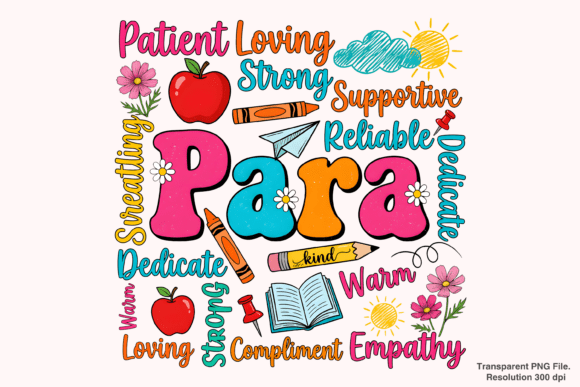
The specific utility of a high-resolution Paraprofessional Appreciation PNG lies in its technical specifications. Professional-grade files typically offer a resolution of 300 DPI (dots per inch) at substantial dimensions, such as 12 × 12 inches. This density ensures that when the image is printed, the edges remain crisp, and text remains legible, regardless of the printing method used. Lower resolution files, often found in free online searches, may appear acceptable on a computer screen but result in pixelation or blurriness when applied to physical goods like hoodies or mugs. The "transparent background" feature is not merely a convenience; it is a functional necessity for professional-looking results, eliminating the need for manual editing to remove unwanted borders.
Comparative Analysis: PNG Versus Alternative Formats
When evaluating resources for creating appreciation gifts, creators often encounter various file types, including SVG, DXF, EPS, and JPEG. Each serves a different purpose, and understanding the tradeoffs is essential for decision-making.
- PNG vs. JPEG: As noted, the primary difference is the background. A JPEG is universally compatible but lacks transparency. If you intend to print on dark-colored t-shirts or clear tumblers, a JPEG will require additional design work to mask the background, whereas a premium PNG is ready for immediate use.
- PNG vs. SVG: Scalable Vector Graphics (SVG) are vector-based, meaning they can be resized infinitely without losing quality. They are ideal for cutting machines like Cricut or Silhouette. However, SVGs do not contain complex color gradients or photographic details as effectively as raster images. A Paraprofessional Appreciation PNG is superior for full-color sublimation projects, direct-to-garment (DTG) printing, or any application where vibrant, multi-colored designs are required without the need for weeding vinyl.
- PNG vs. EPS/AI: Encapsulated PostScript (EPS) and Adobe Illustrator (AI) files are industry standards for professional graphic designers who need to edit individual elements of a design. For the average user, teacher, or small business owner who does not possess advanced vector editing software, these formats can be cumbersome. A high-resolution PNG offers a "what you see is what you get" experience, compatible with most basic design software, making it more accessible for quick turnaround projects.
The decision often comes down to the intended production method. If the goal is heat transfer vinyl (HTV) cutting, an SVG might be preferable. However, for sublimation, screen printing, or direct printing on paper products, the Paraprofessional Appreciation PNG provides the optimal balance of ease-of-use and visual fidelity.
Practical Applications and Best-Fit Scenarios
The versatility of a 12 × 12 inch, 300 DPI file extends across a wide array of creative endeavors. Because the file is large and high-quality, it can be scaled down significantly without compromising integrity, making it suitable for both large statement pieces and smaller accents.
Apparel and Wearables
One of the most common uses is creating trendy t-shirts and hoodies. For school staff appreciation weeks, a cohesive look among paraprofessionals can boost morale. Using a transparent PNG allows the design to be printed directly onto colored garments using DTG printers or transferred via sublimation on polyester blends. The clean edges ensure the design looks professionally manufactured rather than homemade.
Sublimation and Hard Goods
Sublimation printing involves transferring dye into materials like ceramics, metal, and polymer-coated items. This process demands high-resolution images to prevent banding or color loss. A Paraprofessional Appreciation PNG is particularly well-suited for creating custom tumblers, coffee mugs, and keychains. The vibrant design quality ensures that colors pop against the white or light-colored substrates typically used in sublimation.
Paper Products and Stationery
Beyond hard goods, these digital assets are excellent for greeting cards, invitations, and certificates of appreciation. When printed on cardstock, the high DPI guarantees sharp text and clear graphics. This is also a viable option for creating stickers or labels for gift bags, adding a personalized touch to appreciation packages distributed during National Paraprofessional Week or end-of-year celebrations.
Limitations and Decision Factors
While a premium Paraprofessional Appreciation PNG is a robust tool, it is not a universal solution for every scenario. Potential buyers must evaluate their specific constraints before purchasing.
Software Compatibility: Although PNGs are widely supported, users must have access to software capable of handling layers if they wish to combine the PNG with other elements. Basic photo viewers can display the image, but design software (such as Canva, Photoshop, or even Microsoft Word) is required to integrate it into a larger layout.
Color Variance: It is important to manage expectations regarding color accuracy. Digital files are viewed in RGB (light-based) on monitors, while printing occurs in CMYK (ink-based). Consequently, colors may vary slightly due to monitor calibration and printer settings. A design that appears neon blue on a screen may print as a standard royal blue. This is a limitation inherent to all digital-to-print workflows, not a defect of the file itself.
Editability: Once a design is saved as a PNG, the individual elements are flattened. You cannot easily change the font, move a specific graphic element, or alter the color of a single component without advanced photo editing skills. If customization of the text or layout is a primary requirement, a vector file or an editable template might be a better alternative.
Making an Informed Choice
Selecting the right resource for paraprofessional appreciation projects depends largely on your technical comfort level and production goals. If you need a ready-to-print, vibrant, full-color design for sublimation, direct printing, or quick integration into a card layout, a high-resolution Paraprofessional Appreciation PNG is likely the most efficient choice. It removes the barrier of complex design work while ensuring a professional aesthetic.
However, if your project requires cutting vinyl for dark fabrics, or if you need to extensively modify the text and layout elements, you may need to consider vector alternatives or editable templates. For those running small businesses or managing school-wide initiatives, the instant download nature of these files offers significant logistical advantages, allowing for immediate production without shipping delays.
Ultimately, the value of this digital asset lies in its ability to bridge the gap between a thoughtful sentiment and a high-quality physical product. By understanding the technical strengths of the PNG format and aligning them with your specific crafting or printing capabilities, you can create lasting tokens of appreciation that truly reflect the impact paraprofessionals have on their communities.